
Inlays and Onlays
Milwaukie, OR
Inlays and onlays are two types of restorations that repair and restore the surface of a tooth. They are more conservative options than crowns or bridges, preserving more of your natural tooth structure. Both inlays and onlays are custom-fabricated in a dental lab to fit the exact dimensions of the cavity and align with your natural bite. They can be made from composite resin, porcelain, gold, or other metal alloys. An easy way to understand the difference between inlays, onlays, and crowns is by size. Visiting our experts at Sue Walker Dentistry can help determine the best option for your smile.
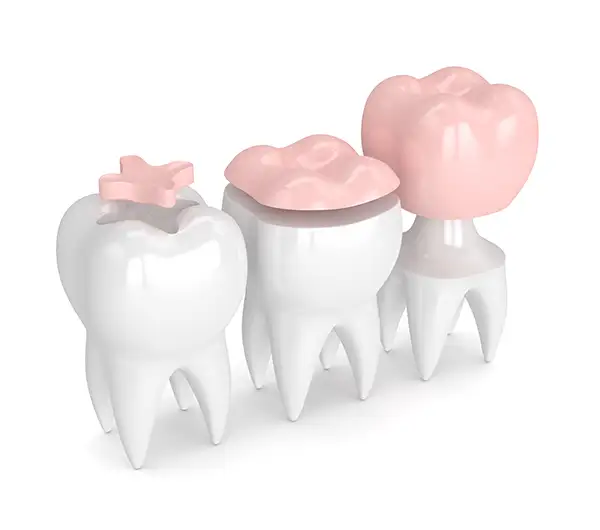
The three restorative procedures vary in size: inlays are small, onlays are medium, and crowns are large. Inlays are ideal for cavities too big for a traditional filling but too small for an onlay. Onlays cover more than just the grooves of a tooth, restoring the chewing surface and sometimes the tooth’s curves. Crowns replace the entire enamel of the tooth and are the largest of the three restorations. Each option is designed to restore both function and aesthetics, ensuring your smile remains healthy and natural-looking.
Inlays
Inlays are a single-piece, custom-made restoration that fits within the cusps of a tooth, bonding directly to the enamel. The benefit of an inlay is that it contracts less than a traditional filling, reducing the risk of bacteria entering the space between the restoration and the tooth. Unlike fillings, which are shaped directly in the tooth after removing decay, inlays are made in a dental lab using an impression of the opposing tooth. The cavity is cleaned, and the inlay is bonded in place as a single piece. Inlays are precise, durable, and can last for many years when cared for properly. They help maintain the tooth’s natural shape, provide a smooth surface for chewing, and minimize stress on surrounding teeth. Patients often notice improved comfort compared to traditional fillings because inlays are designed to match their bite exactly.
Onlays
Onlays are similar to inlays in both fabrication and installation. The main difference is surface coverage: inlays fit within the cusps of a tooth, while onlays cover larger areas that extend over the cusps and sides of the tooth. Onlays can sometimes be used instead of a crown for teeth with moderate decay or damage. They fully restore the chewing surface and are created in a dental lab from an impression of the opposing tooth. Onlays protect the tooth from further wear and fractures while preserving more of the natural tooth structure than a crown. Teeth with significant structural loss, such as those that have had a root canal, may require a crown rather than an onlay, but for many teeth, an onlay is an effective and long-lasting solution.
Choosing The Right Restoration
Determining whether an inlay or onlay is best for your tooth depends on the size of the cavity and the condition of your tooth. At Sue Walker Dentistry, we start with a dental exam to assess your needs and then develop a treatment plan that restores function, appearance, and comfort. We consider the location of the tooth, the materials best suited for durability, and the way your teeth come together when biting. Inlays and onlays provide a strong, natural-looking restoration that can protect your smile for many years. Call us at 971-447-4385
to schedule an exam or consultation and find the ideal restorative option for your smile.